
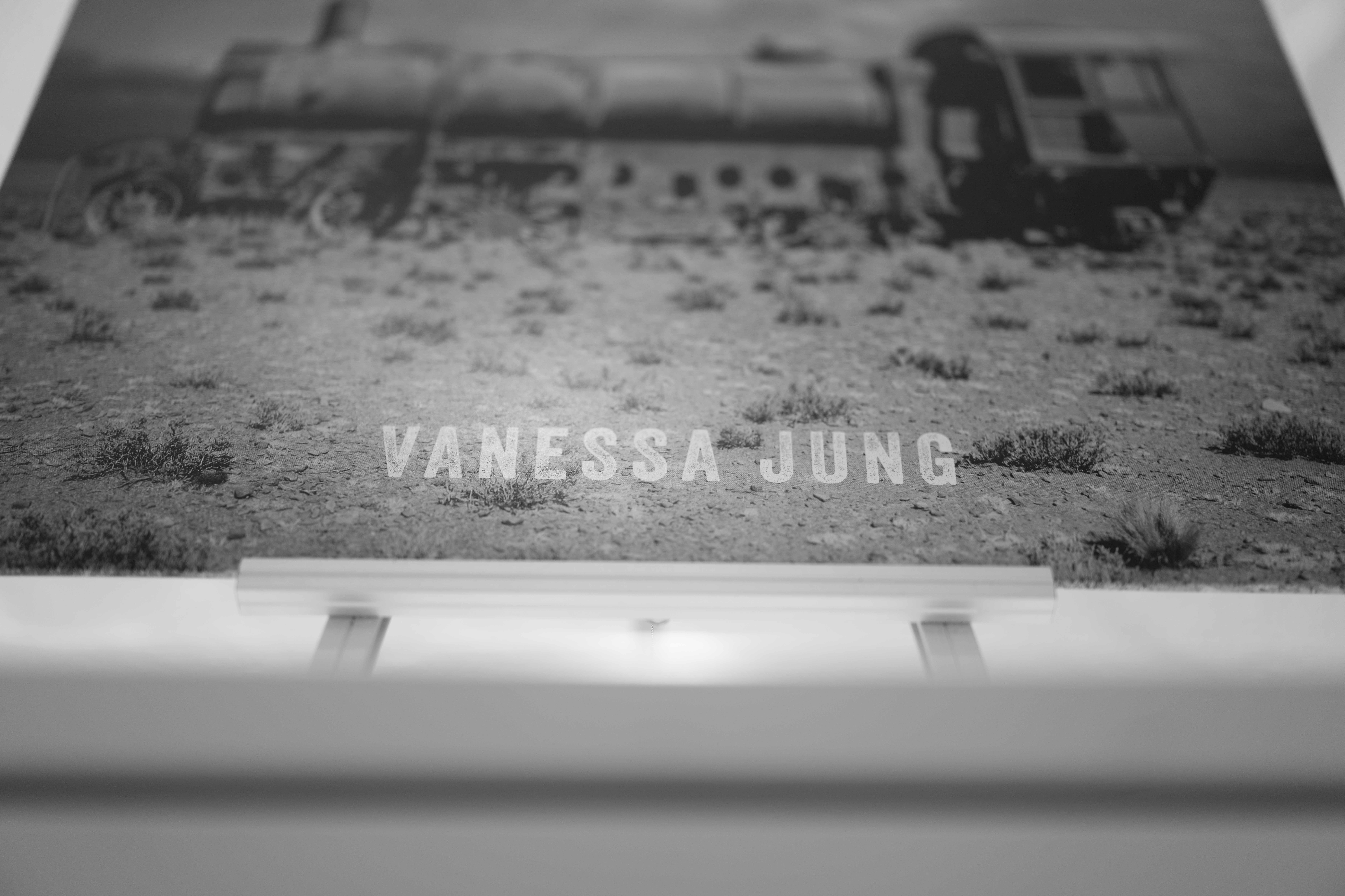
Vanessa Jung – Full Steel

WHERE THE GUITAR TAKES UP THE WORD
A pressing has to carry the mix entrusted to it, and this one asks a great deal of it: it was shaped at the controls of an analogue console whose settings were moved the moment the last touch was made, so that it can no longer be precisely recreated. Does the record carry this one mix into the groove without loss? Can a guitar, on an album that does without vocals on every track but one, take on what a voice would otherwise provide, and what moves a guitarist to commit her riffs to vinyl without words? How much of a band’s shared playing in the same room survives the road over mixing desk and pressing plant to the needle?
At an event held by Sound.In.Grooves I met the Wiesbaden guitarist Vanessa Jung and her father, and she had a white-label pressing of her music with her. Nothing could be said about the sound there, for neither the listening environment nor the stereo system allowed a judgement: masking effects and room influences settled over the musical signal and distorted it. What this music had to offer sonically would have to prove itself elsewhere.

TECHNICAL DETAILS
- Artist / Album: Vanessa Jung – Full Steel
- Label: Vanessa Jung Records (label code 103421)
- Catalogue number: not known
- Recording: March 2025 (basic tracks, two days) and a few weeks later (lead guitars and vocals, two days), Eckton Studios, Holzhausen in the Taunus
- Original release date: 4 September 2026
- Year of this pressing: 2026 (first edition)
- Pressing plant: Optimal Media, Röbel/Müritz
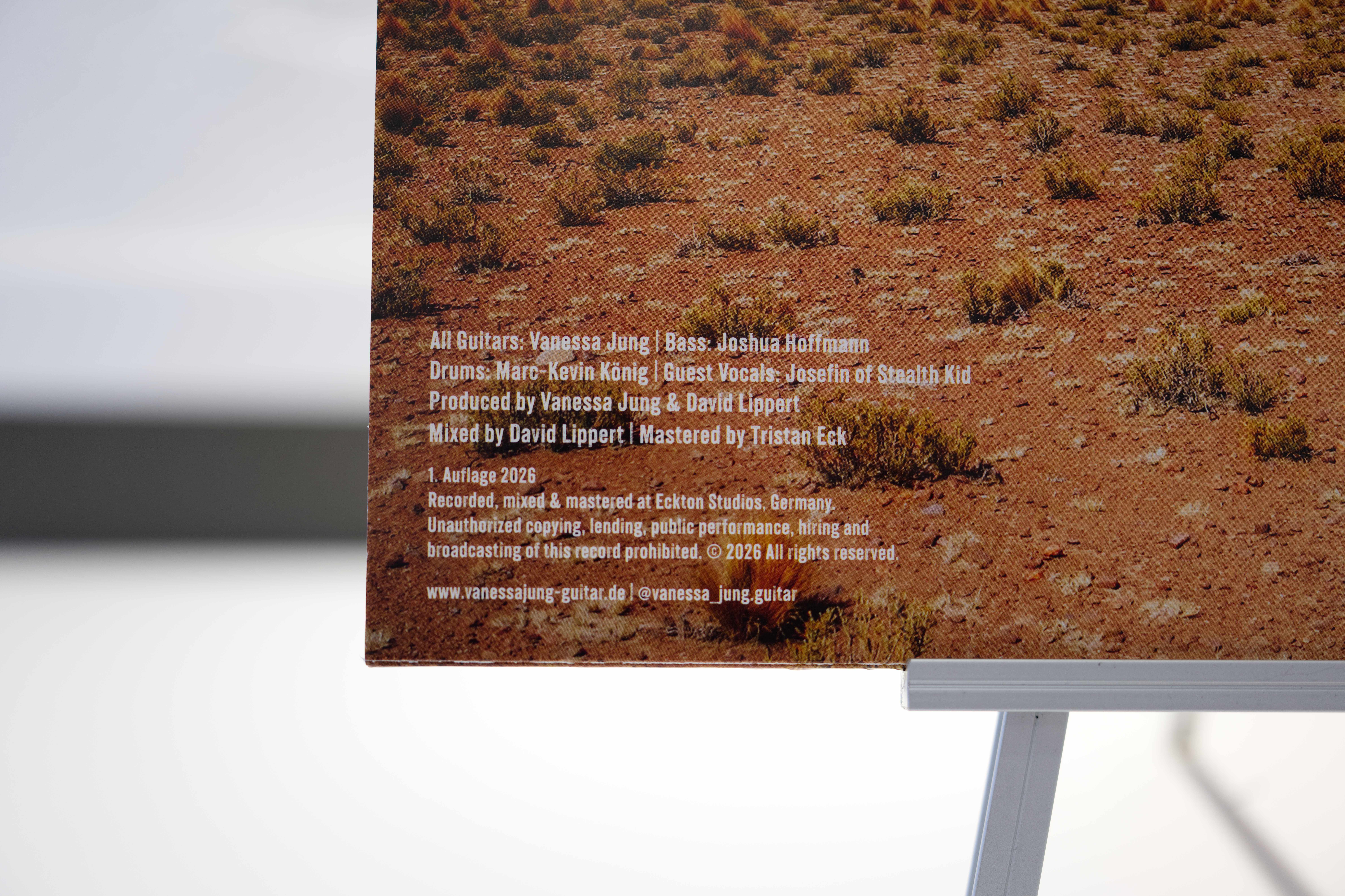
- Producers: Vanessa Jung, David Lippert
- Mixing: hybrid process, editing in Pro Tools, mix formed entirely on an analogue console
- Mastering: Tristan Eck, Eckton Studios
- Cutting source: not known
- Vinyl weight: not known
- Speed: not known
- Format: LP, stereo
- Edition: first pressing of 300 LPs (alongside 300 CDs and 20 white-label pressings)
- RRP: €30 (CD €18, white label €40)
- Personnel: Vanessa Jung (rhythm and lead guitar), Marc-Kevin König (drums), Joshua Hoffmann (bass)
- Guest vocalist: Josefin of Stealth Kid (“Child of the Night”)
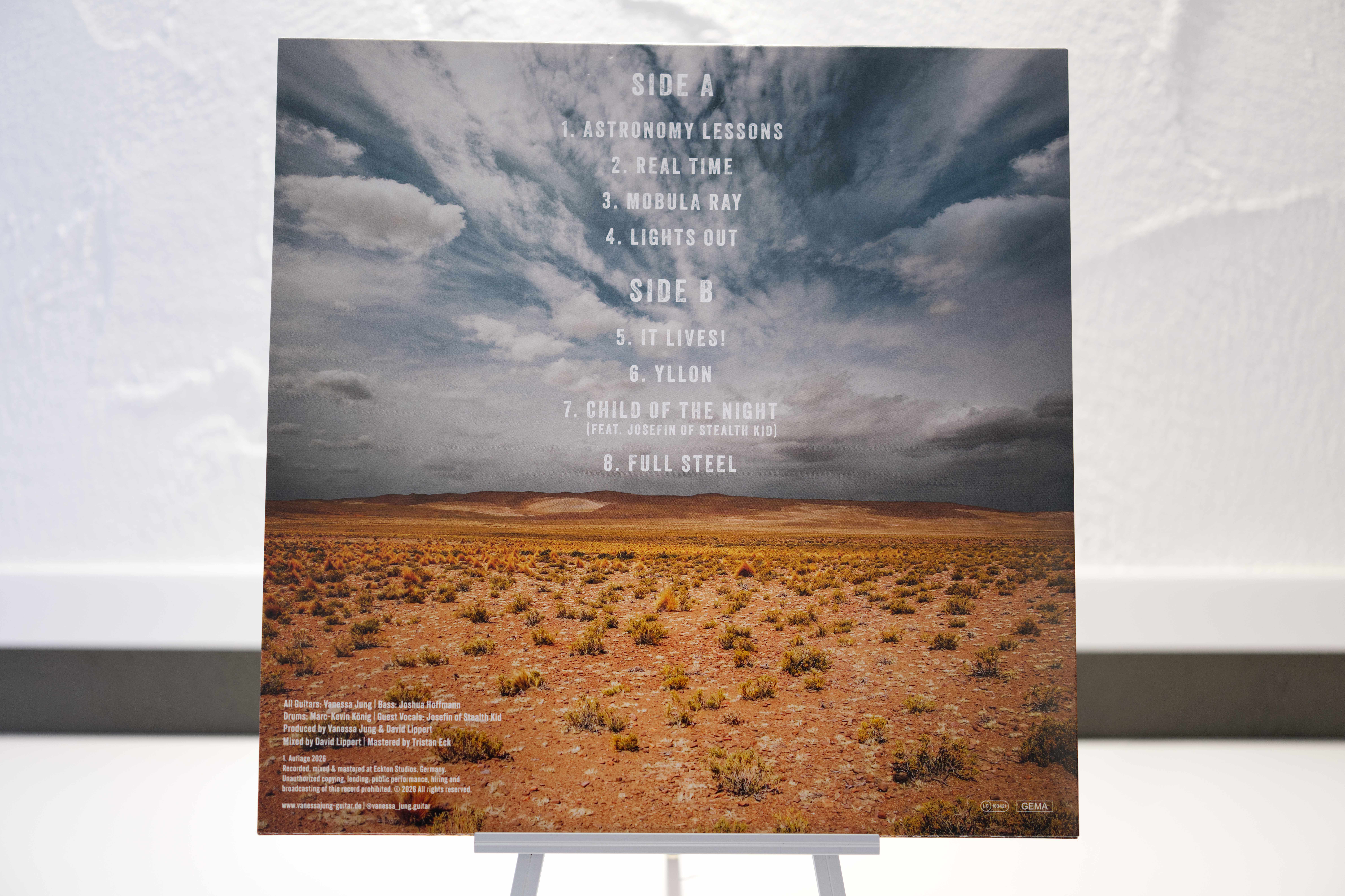
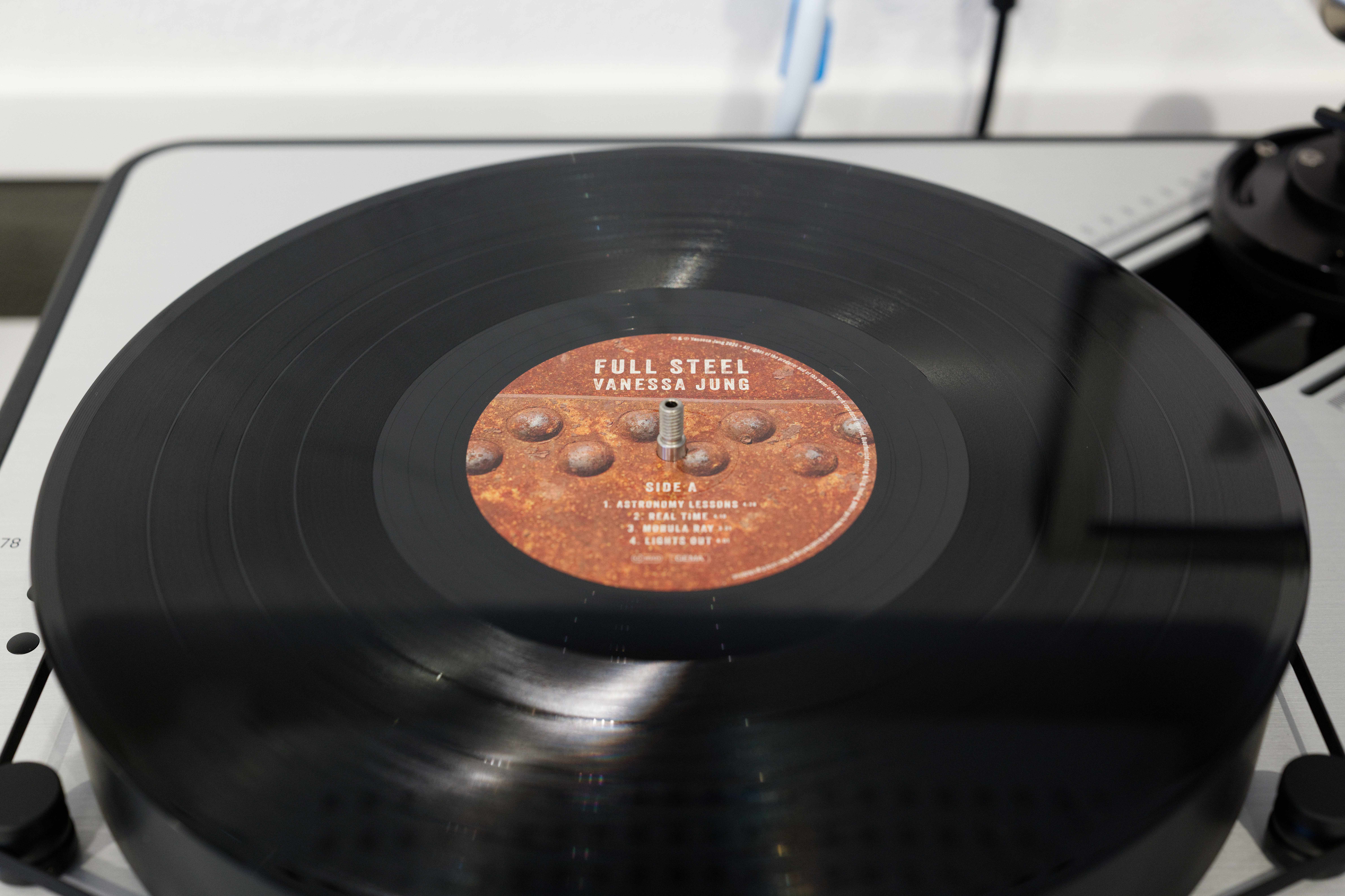
- Side A: 1. Astronomy Lessons, 2. Real Time, 3. Mobula Ray, 4. Lights Out
- Side B: 5. It Lives!, 6. Yllon, 7. Child of the Night, 8. Full Steel
THE ARTIST AND THE ALBUM IN CONTEXT
Vanessa Jung’s connection to the record began in a local vinyl shop she used to visit with her father, still in her pram. Later she sat playing in the family living room in front of shelves full of records, Metallica standing beside AC/DC and Iron Maiden, and at home and in the car everything ran together, from rock to jazz and classical music. Her first album, then, had to appear on vinyl above all else, though a long road led there, one that began with a guitar.
At seven or eight she picked up the guitar, and when she was around twelve her father asked whether she might like to try an electric one. Soon after, she discovered Guns N’ Roses, and Slash became one of her first guitar heroes. At thirteen she stood on a stage for the first time, and more than 300 performances were to follow.
A 2016 concert by Animals As Leaders, with Plini in the support slot, drew her into the modern instrumental scene, one she had barely encountered before. Two years later, in 2018, she began her studies at the Popakademie Baden-Württemberg in Mannheim, the institution that in 2003 had become the first of its kind founded in Germany. She majored in electric guitar for both her bachelor’s and master’s degrees, and she was the first woman to study that principal subject, a fact she finds more sad than notable.
For her application she needed a piece of her own, one that demanded more of the guitar than a pop song, and because no voice was found that suited her riffs, she wrote it without vocals. That was how “Mojácar” came about, her first instrumental song, which is not found on this album.
Her master’s graduation concert was conceived as a journey through different worlds, with a backdrop of its own devised for the band behind each piece. Space was assigned to “Astronomy Lessons,” the ocean’s expanse to “Mobula Ray,” the title track “Full Steel” led into the desert, “It Lives!” into the jungle and “Child of the Night” into a city at night. “Lights Out” and “Real Time” were added only after that concert.
In 2022 her first three singles appeared, “Mojácar,” “Shakespeare Avenue” and “Carved in Stone,” each accompanied by a music video, and in parallel she put together a live band. Their first performance followed in early 2023, and since 2024 the band has played in its current line-up: Marc-Kevin König on drums, Joshua Hoffmann on bass, David Lippert on rhythm guitar and Vanessa Jung on lead guitar, joined at individual shows by Josefin of Stealth Kid, who sings “Child of the Night” as guest vocalist.
In March 2025 the band spent two days at Eckton Studios in Holzhausen in the Taunus, a house with two control rooms and four recording spaces across 400 square metres that can accommodate even choirs and big bands. Drums, bass and rhythm guitar were recorded there together, rather than instrument by instrument in sequence, so that the musicians could see one another and respond to what they heard. David Lippert, who takes rhythm guitar live, sat at the mixing desk in the studio; the rhythm guitar itself was played by Vanessa Jung, and Theodor Henn assisted as second engineer with setting up and positioning the microphones. Only a few weeks later, in a second two-day session, came the lead guitars and the vocals for “Child of the Night.”
Who might rightly be called this album’s producer occupied Vanessa Jung in earnest, for the word carries two meanings. In its classic sense, a producer is whoever finances and organises an album, and that was her role, while today the word is more often understood as the person who carries out the audio production, a task that lay entirely with David Lippert. Both are therefore credited as producers. Her aim was a sound that felt raw and organic rather than polished and sterile, and the approach of playing together in the room stands, to her mind, in deliberate opposition to a recent trend toward playing ever more perfectly and mechanically to the grid.
The rhythm guitars of the basic tracks ran first through a Fractal FM3. The lead guitars, played in roughly equal measure on an Ibanez AR420 and a Schecter Hellraiser C-1, went into a BluGuitar Amp1 on its Classic Channel, driven very loud into an Orange four-by-twelve cabinet in a separate room and miked in entirely conventional fashion. With a few exceptions, David Lippert later reamped the rhythm guitars through this same amplifier as well, so that on the finished album the Amp1 dominates throughout. For a few clean parts a Stratocaster that happened to be in the studio was brought in, because the other guitars did not deliver the same crystalline top end.
“Full Steel” appeared on 4 September 2026, and the following day came the release concert at the Romanfabrik in Frankfurt. With no record company behind her, Vanessa Jung planned the album independently, and she describes it as a low-budget production, which only sharpens one’s curiosity about the pressing.
THIS EDITION
Among the twenty white-label pressings that, alongside 300 LPs and 300 CDs, make up the first edition, is one I bought myself, because the music had gripped me on the spot: a driving force wherever I listened. The record under review here was supplied to me as a review copy, and no business relationship exists with the artist or the label.
Vanessa Jung Records is the label under which the record appears, and it was pressed at Optimal Media in Röbel an der Müritz, a plant that began operating with CDs in 1991, has also made records since 1995, and unites every step of vinyl manufacture under one roof. Mastering was handled by Tristan Eck, head of the Eckton Studios in which the album was recorded.

PACKAGING
The path from sleeve to needle is a path taken by hand, and it begins with a package that stays modest where expense would catch the eye and shows care exactly where the record needs it. The cover carries a collage of photographs assembled by Luise Anna Heinig, lending the sleeve a hand of its own, yet it comes without a gatefold and without embossing, remaining a simple cover whose execution betrays nothing out of the ordinary.
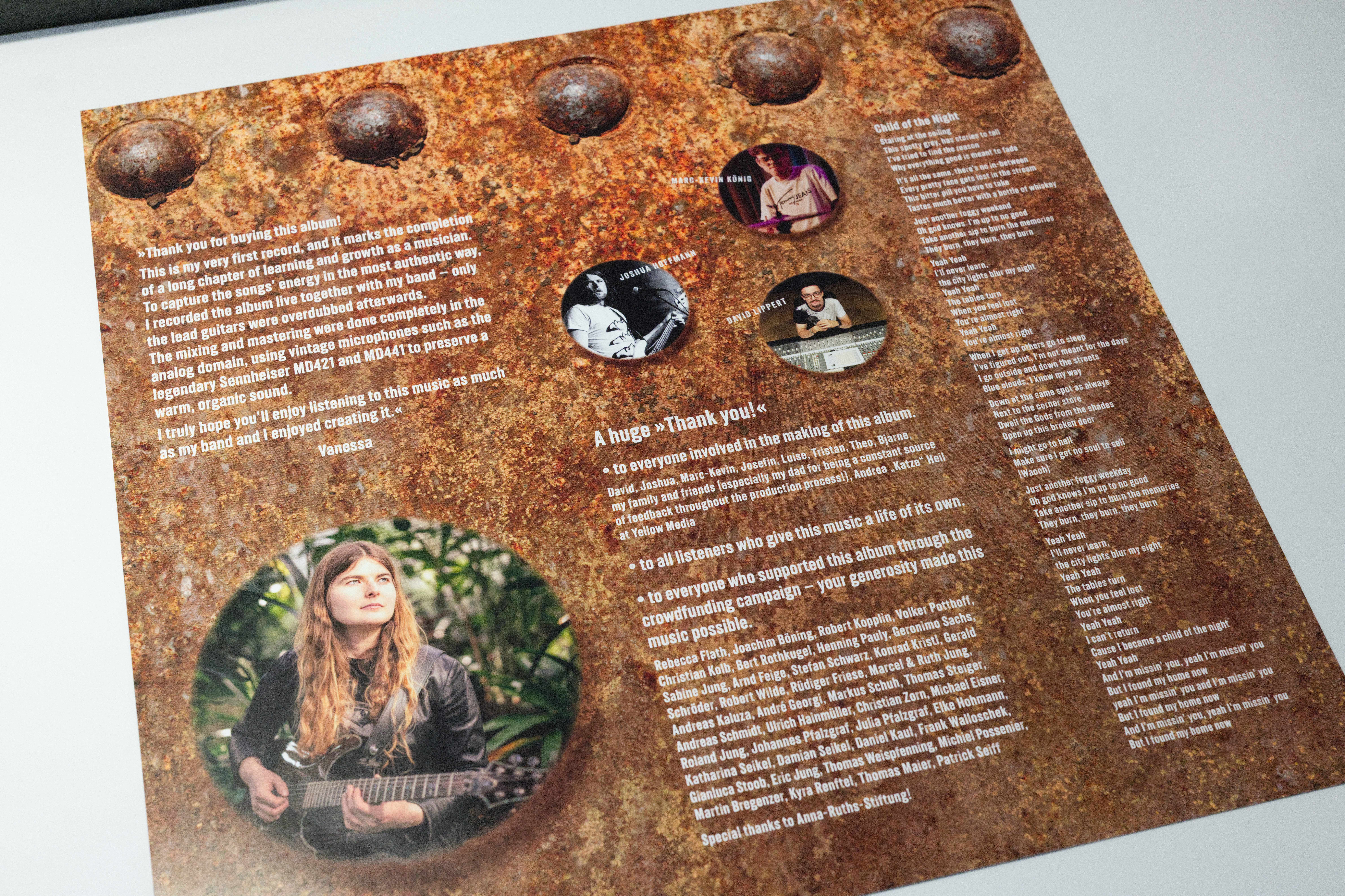
Draw the record out and a lined inner sleeve protects it, performing its task without reservation and keeping the surface free of scratches. A printed inner sleeve is unfortunately not included. A single sheet, printed on both sides, stands in for a booklet; turned over once, it offers thanks and credits along with the lyrics to “Child of the Night,” alongside press photographs by Bjarne Stahmer and pictures of the individual musicians. Photographs from the recording session whose shared playing in the room defines the album are unfortunately not included, nor are any further enclosures.
PHYSICAL QUALITY
Whoever draws the disc from its inner sleeve and turns it over for inspection holds a piece of vinyl that, on the whole, earns a good verdict and does not quite withstand scrutiny at a few points. The edges are only partially rounded off, and the disc shows a slight warp, minor enough that together they only mildly cloud the picture of an otherwise cleanly pressed record.
On the platter it sits convincingly centred despite a minimally oversized spindle hole. As the stylus sets into the groove, faint residue remains on it, and a discreet groundswell of surface noise accompanies the music, from which, very rarely, a tick or a pop breaks loose. How much of this the music leaves untouched is the subject of the chapter on sound.
SOUND QUALITY
As the tonearm lowers into the first groove, a soundstage of striking breadth opens before me. The two rhythm guitars stand left and right, lead guitar and bass guitar hold the centre, and the drums appear from the drummer’s own vantage point: the snare sits centre, the hi-hat half left, the floor tom right, the ride cymbal half right, and the crash cymbals open out to both sides. It is precisely this breadth that troubles me, for the drums are spread wider than I would wish. I want to sit facing the drums, not on the drummer’s own stool, and a more compact presentation would suit the recording better. How the individual drums hold their ground within this wide field is clearest in the toms.
At the toms, the sharpness of imaging fades. They sit half left and half right, yet their position can only be approximated, while the other sound sources hold their places with markedly greater certainty. This one blur stands out all the more because imaging otherwise convinces clearly and runs well ahead of the soundstage, where the drums’ breadth delivers rather too much of a good thing. Whether the frequencies hold their ground just as surely is shown by the second track.
In the second track, “Real Time,” drums and bass guitar open a view onto a small unevenness: in the transition from upper bass to lower mids sits a narrow frequency band that is a touch too pronounced, and it is on these two instruments that it is best followed. Everything else falls into place so evenly across the frequency band that tonal balance counts among the record’s clear strengths, diminished only by this one zone. Whether it holds its composure at high volume too will be shown by the end of the second side.
When the snare strikes and the toms follow, the final vehemence is missing: where the music calls for a fortissimo, a mezzo forte sounds instead. The drums lack that final push, and although dynamics as a whole convince for the most part, the deduction falls squarely there.
With the stringed instruments, it is definition rather than force that comes into view. The bass guitar lacks a touch of contour, the guitar could use more grip and a sharper line, and bass reproduction as a whole remains good without quite delivering on all of it. That there is more in it becomes apparent only toward the end.
Over the entire recording lies a veil, one I as a listener would gladly draw back to see the music more clearly. Detail and transparency hold to a solid level, as do the mids and the treble, yet in none of these areas does the recording reach the clarity I find myself longing for. Then I turn the record, and the second side has a voice in store.
In the seventh track, “Child of the Night,” a voice joins in for the first time, that of the guest vocalist, and it stands centre stage. Toward the end of the track an acoustic guitar joins it, one that had already been present in the demo and to which Vanessa Jung owes a small campfire atmosphere. The voice itself convinces with minor reservations, and after it only one track remains.
At the end of the second side, in the title track “Full Steel,” everything falls into new order. The bass solo emerges together with the drums, and the bass guitar gains the contour it lacked before. When the dirty guitar riffs join in, the music insists, with real force, that I turn the volume up, and the level may rise, since the tonal balance holds its composure even at high volume. So bass, drums and guitars reach, at the close of this debut, the raw, energy-charged character the music has promised from the start.
MUSICAL CONTEXT
On this record the guitar takes on the role of the voice, and the pieces are built like songs: verse, chorus and pre-chorus, a bridge, and then the solo, just as Vanessa Jung holds them in her head, with a striking opening riff usually forming the starting point of her songwriting.
Her music moves between classic rock and modern instrumental music, and among the models she translates into a language of her own rather than quotes are Slash and, alongside him, Gary Moore. Rather than aiming for extreme displays of technique, she favours virtuosity that serves the song, and the instrumental scene’s pursuit of higher, faster, further holds little appeal for her. She has always been drawn to pieces that begin slowly and build toward the end, and in the title track the drum groove shifts beneath the same riff, carrying the whole mood with it, an idea she knows from Pantera.
ASSESSMENT
Weighed in its parts, this record carries its greatest weight in the sound, and its verdict is largely one of praise, with its limits clearly named. Tonal balance and imaging stand at the front and carry the clearest praise, while soundstage, dynamics and resolution, along with bass, mids and treble, remain at a good level, held back by drums that lack restraint in their breadth and that final push, and by a recording that has not yet reached its full clarity. The vinyl keeps pace with the sound, for its good qualities are met by small deductions of their own. The packaging falls behind both, kept simple as it is, earning full applause only in the lined inner sleeve. What emerges is the picture of a debut that has largely succeeded, one whose limits can be named with precision.
CONCLUSION AND RECOMMENDATION
The question at the outset was whether the pressing could carry this unrepeatable sound picture without loss, and the answer is: a great deal of it, if not quite everything. The guitar carries the pieces without a voice, and in the title track it delivers the proof. What moved Vanessa Jung to commit her riffs to a record without words is answered by the album itself: it sounds handmade and energy-charged, carrying the breath of a band finding itself in the same instant. Musically, she has won me over; I am a fan, and I take my hat off to this handmade music.
I hope this record was only the beginning, that the next album leaves every objection behind and becomes, like Metallica’s Black Album, a sonic manifesto of rock history, for I credit this talented band with nothing less. Until then, I recommend the LP, at its recommended retail price of thirty euros, to anyone who values rock music without polish, and I advise a generous hand on the volume dial. Anyone who demands drums of the utmost force and a fully unclouded view of the recording should listen for themselves and decide. Should the next album truly put my objections to rest, I shall of course claim I dictated it to the band myself in the studio, for laying claim to another’s achievements is among the oldest customs of my profession.